
Cart
There are no more items in your cart
Total:
€0.00
Show 1-12 in 27 products.
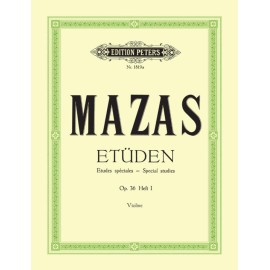


Jacques Féréol Mazas (1782-1849) was a French composer, conductor, violinist and pedagogue, and many of his compositions were studies and methods for young violin and viola students. His three progressive volumes of violin études, 75 Études mélodiques et progressives, Op. 36 - Volume 1 (Études spéciales), Volume 2 (Études brillantes) and Volume 3 (Études d'artistes) - are considered classics of violin pedagogy and have been in constant use by violin students and teachers since they were published.
The Danse Macabre is one of the most celebrated works of Camille Saint-Saëns and of the French symphonic repertoire in general
This score has been beautifully realised for violin and piano - guaranteed to bewitch audiences!
This series offers a versatile selection of themes from classical favorites for flute, clarinet, alto sax, tenor sax, trumpet, horn in F, trombone, violin, viola, and cello. Each book contains carefully edited arrangements appropriate to each instrument, and well suited for level 1 students. The online media includes a fully orchestrated demo track of each song, which features a live instrumental solo performance, followed by a play-along track. Also included are PDFs of piano accompaniments, and Alfred's Tempo Changer Software.
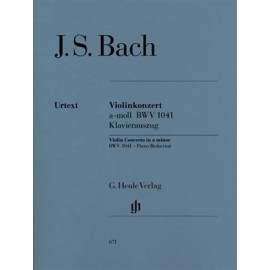
For the editor of an Urtext edition, Bach’s A minor violin concerto BWV 1041 presents few problems, cleanly-written original parts exist from Bach’s Köthen (or early Leipzig) period.
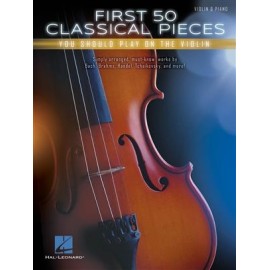
50 simply arranged, must-know works by Bach, Brahms, Handel, Tchaikovsky and more for violin! The book includes piano accompaniment and a separate pull-out part for violin.
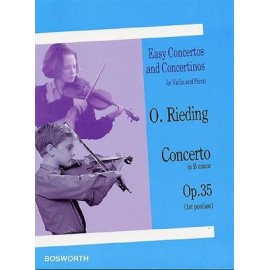
Oskar Rieding’s Concerto in B minor, Op. 35 is a spirited and relatively simple work, using the first position only. This piece is part of Bosworth’s Easy Concertos and Concertinos series.
As Court Music Director in Cöthen, Johann Sebastian Bach devoted himself primarily to instrumental music. Among the works written there were his Sonatas for violin and obbligato harpsichord BWV 1014–1019, which have come down to us as a complete cycle.
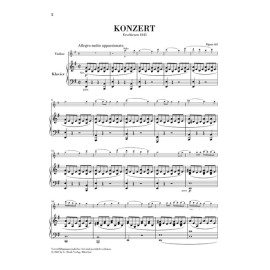
For the first time this celebrated concerto will now appear in a source-critical edition. Ullrich Scheideler depicts how the work evolved, describes its sources, and comments on the musical text. The well-known violinist Igor Ozim has marked up Mendelssohn’s approved violin part, adding fingering and bowing marks as an aid to today’s performers. He has also supplied a separate commentary showing that Mendelssohn’s autograph already contains useful suggestions for shaping the solo part. The piano reduction a revised version of the one that accompanied the first edition lies well under the fingers while remaining as faithful as possible to the original text.
G. Schirmer's edition of scores of orchestral works and chamber music.