
Cart
There are no more items in your cart
Total:
€0.00
Show 1-12 in 209 products.






46 pieces by CPE Bach, JS Bach, Bartók, Beethoven, Burgmüller, Clementi, Ellmenreich, Grieg, Gurlitt, Handel, Heller, Kullak, Petzold, Reinecke, Schumann, Streabbog, and Tchaikovsky.
All are at the early intermediate level in a slim, affordable volume.
Liszt made significant contributions to piano literature. Consolations and Liebesträume were first published in 1850 and have become Liszt's most approachable and recognisable pieces.
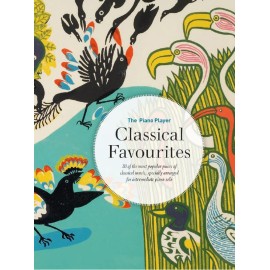
The Piano Player: Classical Favourites presents 20 of the most popular pieces of classical music, specially arranged for intermediate solo piano.
Contents include Eine Kleine Nachtmusik by Mozart, Fantasia on Greensleeves by Ralph Vaughan Williams and Un bel dì, vedremo by Giacomo Puccini.
The Danse Macabre is one of the most celebrated works of Camille Saint-Saëns and of the French symphonic repertoire in general
This score has been beautifully realised for violin and piano - guaranteed to bewitch audiences!
This beautiful book is arranged for intermediate solo piano and is an essential staple for all pianists!
Le Carnaval des animaux was conceived in a small Austrian village, while Camille Saint-Saëns was working on his 3rd Symphony with organ, opus 78. Afraid that this humoristic fantasy could cause his oeuvre to be taken less seriously and harm his reputation, he forbade its being published during his lifetime.
“Grande Fantaisie zoologique” is composed of 14 movements and the instrumental ensamble of the original version included two pianos, two violins, viola, cello, double bass, flute, clarinet, glass harmonica [celesta] and xylophone. The Final is the only movement in which all instruments play together.
Lucien Garban, official arrenger ARRANGER of Éditions Durand, was responsible for numerous arrangements of the Carnaval des animaux, notably a version for solo piano that was realised in several stages but released in its entirety in 1951; while in 1922 realised the 4-hand piano transcription. Introduction and notes on interpretation in French and English by Edmond Lemaître.
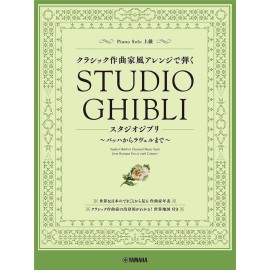
This Studio Ghibli piano collection includes 15 beautiful arrangements in the style of major classical composers: Vivaldi, J.S. Bach, Mozart, Beethoven, Schubert, Chopin, R. Schumann, Liszt, Saint-Saëns, Debussy, Rachmaninoff, and Ravel.
The gorgeous compositions are richly decorated with phrases and styles unique to the four main eras of the above classical composers: Baroque, Classical, Romantic, and Modern.
It's perfect for live performances as well as lesson repertoire. We hope you enjoy!
Johann Sebastian Bach's three great cycles of suites belong to the fundamental canon of piano literature: the Partitas and the so-called English and French Suites.
2 Arabesques (L. 66), is a pair of arabesques composed for piano by Claude Debussy when he was still in his twenties, between the years 1888 and 1891. The work, edited by Hans Swarsenski, is regarded as one of Debussy's most well known works.
Beethoven: Masterpieces for Piano brings together original piano works by Ludwig van Beethoven, suitable for intermediate to advanced level players. Arranged in progressive order, the collection includes a mixture of favourites and lesser-known works. The cover design features a painting by John Martin, Sadak in Search of the Waters of Oblivion (1812).
The Masterpieces for Piano series presents superb collections of core repertoire by the great piano composers. These beautifully produced, carefully curated editions provide pianists with an excellent overview of each composer and should be an essential part of all players’ libraries. Suitable for intermediate to advanced level players.
Schubert: Masterpieces for Piano brings together original piano works by Franz Schubert, suitable for intermediate to advanced level players. Arranged in progressive order, the collection features a mixture of favourites and lesser-known works, with a complete sonata – Sonata in A major, D664 – at the end of the book. The cover features Wasserfall mit Mühle by Austrian painter Albert Rieger (1834–1905).
The Masterpieces for Piano series presents superb collections of core repertoire by the great piano composers. These beautifully produced, carefully curated editions provide pianists with an excellent overview of each composer and should be an essential part of all players’ libraries. Suitable for intermediate to advanced level players.
Mozart: Masterpieces for Piano brings together original piano works by Wolfgang Amadé Mozart, suitable for intermediate to advanced level players. Arranged in progressive order, the collection includes a mixture of favourites and lesser-known works, with a cover design featuring Jean Honoré Fragonard’s painting, The Swing.
The Masterpieces for Piano series presents superb collections of core repertoire by the great piano composers. These beautifully produced, carefully curated editions provide pianists with an excellent overview of each composer and should be an essential part of all players’ libraries. Suitable for intermediate to advanced level players.
A collection of prose poems by the French Romantic Aloysius Bertrand inspired Ravel to write his piano cycle “Gaspard de la nuit”. Unlike earlier works he does not merely create an atmospheric depiction of the literary model in a fascinating manner he recounts the eerie-grotesque scenes using musical means. His “three romantic poems of transcendental virtuosity” were supposed to surpass the technical refinement of Balakirev’s “Islamey” (HN 793), which was considered unplayable at the time. Our edition not only offers impeccable Urtext in a clear, larger format: the corresponding poem by Bertrand prefaces each part in three languages.